Showing posts with label World Cup 2018. Show all posts

Tuesday, 12 June 2018

VAR Revisited: Judgement Day Approaches


Thursday will play host of the 21st edition of the FIFA World Cup in Russia, but also the first to use VAR (Video Assistant Referee) technology. After a rough ride since its inception, FIFA’s sometimes blind ambition to pioneer this approach has led to numerous instances of error, confusion and delay that has widely split the footballing fraternity of how best to move forward. A year on from my initial questioning of this approach, I suggest that the early teething pains being felt are more likely to be long term symptoms of a technology that doesn’t quite fit the sport.

From the outset I’ve long been a critic of using video technology in football. Proposing that a categorical decision can be made on matters of opinion has always struck me as merely adding another layer of contention to an already heated arena. The subsequent delay and confusion would also in my opinion damage the essence of why football is so loved.

Off the back of a mixed pilot at the latter end of the 2016/17 Australian A-League season, I detailed a number of failings, highlighting further concerns that needed to be ironed out in the subsequent year ahead of the World Cup. The last 12 months however have done little to suggest this has been achieved.

The decisions up for consideration remain the same; 1) circumstances surrounding goals being scored, 2) penalty decisions, 3) red card incidents and 4) mistaken identity. While the initial pilots experienced quite significant failings in Australia and at the Club World Cup, the full season rollouts were introduced as agreed, in the German Bundesliga, Italian Serie A, Portuguese Primeira Liga, sporadic English FA Cup ties and a full season with the A-League, alongside the FIFA competitions; Confederations Cup, U20 World Cup, Club World Cup and sporadic international friendlies. The testing ground was now vast, but with it came the inevitable hand-in-hand controversies.

The three areas of concern raised last year were the wide interpretation of the rules, the time delay in making the decisions and the behaviour on the pitch, which all had a significant part to play over the last 12 months. However, an additional concern can now be added to the list of snags; that being technological malfunction.

Interpretation

One of football’s enduring qualities has always been its freedom. There’s no steadfast way of playing the game and with it means there’s few laws that can be considered as categorical. While Goal Line Technology (GLT) has developed quickly into being a mainstay of modern football, VAR was always fighting an uphill battle as it considered multiple shades of grey over the unquestionable decision of whether a ball had crossed the goal line or not. 

Last summer’s Confederations Cup, the official warm up for this year’s World Cup had a number of interpretation issues that caused upheaval. Chile were denied a VAR review upon a clear enough looking penalty decision against Portugal in the semi-finals, while they conversely were the beneficiaries in the final when Gonzalo Jara was spared a red card upon an on pitch review for an equally clear elbow on Germany’s Timo Werner. 

Later that year, at December’s Club World Cup, Real Madrid who were affected by the VAR at the previous edition in 2016 were under scrutiny once again. On two occasions during their semi-final with Al-Jazira VAR stirred up confusion; first a goal for Casemiro was ruled out, overturned, then ruled out once more due to an open for interpretation offside decision against Karim Benzema which questioned whether he was interfering with play or not. 

Secondly, Al-Jazira had a goal ruled out for offside, when Mbark Boussoufa was judged to be offside (after a significant delay), again a call that caused debate. After the match Real coach Zinedine Zidane and player Luke Modric spoke of their frustrations of the system, citing their confusion and the scope for interpretation as the technology’s limiting factors.

The issues that VAR highlights tend to become more defined when a supporter’s team is affected, highlighted perfectly by the England national team over the last 12 months. Firstly, Raphael Varane was sent off for France against England in Paris last summer for a soft but likely last man foul on Dele Alli, widely praised in the country as a clear example as to why video technology was first introduced.

Fast forward nine months and the shoe was on the other foot, as England conceded a soft penalty to Italy after VAR intervention. Both decisions were very similar; clumsy but contestable. Predictably however there was outcry on this occasion; as former national team striker Gary Linekar put it England had a “clear and obvious victory taken away” from them. He, like many pundits that night pointed to the rules that state an overturned decision needs to be “clear and obvious”, while in the same year the same group of observers didn’t bat an eye lid at the red card awarded to Varane.

Time Delay 

There have been countless cases where VAR has worked perfectly, either as a sanity check to ensure the referee has made the correct call first time around or to pick up something that was initially missed. However, in plenty of cases this process has been lengthy and often misleading for fans in the ground and broadcasters/viewers around the globe watching on TV.

The most famous example occurred in Germany in April, when a relegation “six pointer” between Mainz and Freiberg descended into farce, as players were brought back out of their half time break to conduct a penalty for an incident that happened a good five minutes ago in the first half. Alongside the impeding logistics of recalling players out of the tunnel (some of whom didn’t even reappear for the penalty to be taken), fans who had made their way downstairs in the ground and TV broadcasts on ad breaks would have critically missed a key part of the action.

Concerning in-play decisions, some calls are also demonstrably time consuming to resolve. Central Coast Mariners midfielder Wout Brama’s eventual red card in the A-League took a whole two minutes, from initial yellow to its eventual upgrading. A short period of time on paper, but as can be attested on video footage a lengthy period that raised tensions on the home bench, particularly with coach Paul Okon.

Behaviour on the pitch

FIFA have taken preemptive action on the behaviour of players calling for a VAR check, insisting any call for such would be punishable by a yellow card. Given the lack of success FIFA and national leagues have had in clamping down on dissent towards referees from all quarters, it’s debatable this extra legislation will have any effect, but at the very least FIFA are accepting changes in behaviour have occurred since VAR’s implementation.

Players and coaches objection to initial decisions and the follow up reversions will be pointed to as passion, part and parcel of the game, but the question clearly is to why bother in introducing a system that exacerbates the debate rather than resolves it? The long term future will pile more pressure on the referees instead of the technology being there to support them, leading to occasions where referees are clearly changing the way they officiate.

In Australia, it has been regularly debated whether officials are often overlooking decisions, as they’ll be picked up by VAR anyway, to ensure a chance isn’t lost in real time play. The opposite happened in last summer’s U20 World Cup final between England and Venezuela. Venezuelan forward Adalberto Penaranda went down in the box under the challenge of Kyle Walker-Peters, which was quickly blown up by the referee as being a penalty.

Upon immediate questioning the referee rushed the decision up to the VAR box, seemingly suggesting, “I couldn’t be sure, but it’s getting checked over,” bringing the updated VAR processes into doubt, as referees are negating their initial job of making the decision on the pitch as they see it.

While the decision was agreed upon, or at least not seen as a “clear and obvious” mistake by the referee, even though from a personal standpoint there looked to be minimal to no contact, the resulting penalty was missed by Venezuela, muting any hard feelings from the England bench. A bullet dodged for the referee and FIFA, but questioning should be directed on the consistency in the use of the technology between individual referees. 

Technology Malfunction 

One aspect I hadn’t considered this time last year, was that the technology wasn’t fit for purpose in the required moment. The comical graphics used by the VAR team behind the FA Cup tie between Huddersfield Town and Manchester United went viral, as Juan Mata was called offside for United, justified by an uneven yellow line across the field. Hawk-Eye, the operators behind the technology put it down to a glitch in the system.

This year’s A-League Grand Final went one step further and saw its VAR system switch off for two minutes. While this could’ve happened another time to little effect, the period in question saw Melbourne Victory score the only goal of the game, despite the television audience being fully aware that James Donachie was offside in the build-up. The outcry was tremendous, but crucially for FIFA isolated in a low key league outside of Europe, but a comparison to a winning goal in the World Cup final would be disastrous. Despite a lengthy explanation citing a technical failure, the FFA have agreed to use VAR in next season’s A-League campaign.

Ironically after the affair, there were calls for the VAR referee in question to be banned from ever taking up the role again, irrespective of his lack of technological expertise. This surely culminates the VAR’s ludicrous moral 360, from introducing technology to take the pressure off referees, we are now calling into question the careers of those using it.

Quite possibly the most bizarre example however, came in Portugal, when a clear offside goal scored by Aves v Boavista in the Portuguese Primeira Liga was missed by the VAR cameras as a supporter’s flag was flown in the way of its sight. Clearly the most surreal incident in VAR’s short history, it’d likely raise a few smirks even from the Boavista fans, if we weren’t used to so many damning clangers in the past.

Throughout all this, FIFA carries on regardless to push their opinion that VAR has been of benefit to those who have introduced it into their competitions. An IFAB report from January suggested decision making has improved, from 93 to 98.9% success rate, yet still the biggest players in club football continue to be unimpressed.

In February, UEFA confirmed that they weren’t going to use VAR in their upcoming Champions League campaign, while the English Premier League followed suit in April stating; “The decision came after comprehensive discussions regarding the progress made in VAR trials in English football and key learnings from the many competitions elsewhere using it.”

It’s probably a wise decision for both organisations to take, given they haven’t yet experienced the crisis moments that FIFA had, back in 2010, where a few clear decisions were missed in South Africa’s staging of the World Cup. But even for those who were initial pushers of VAR, regular use has seen their opinion change.

As we edge towards the biggest football competition in the last four years, the previews have quite sensibly been looking at the players and teams that will hopefully make the headlines come the World Cup final. While I may speak as an unwavering sceptic of VAR, I can’t foresee a scenario where at least one team won’t be negatively impacted by the use of the system however. While question marks and technical bugs continue to hover over it, VAR will always be lurking ready to tarnish the greatest show on earth.

Friday, 8 June 2018

World Cup 2018: Japan (Preview)


Heading into their fifth consecutive World Cup, expectations couldn’t be much lower for fans of the Japan national team. Onto their fourth manager in as many years, the spotlight needs to be turned on the players, as they look to put to bed the demons of Brazil four years ago.

Managerial changes aren’t exactly a rare occurrence in Asia. Of the five qualified AFC nations (yes, teams that met their objectives), four go into it under a different coach within the last 12 months, three are set to swap coaches after the World Cup, while the other two won’t be unexpectedly moved on either.

In a region of flux Japan have peaked in their axe wielding, firing Alberto Zaccheroni after a failed World Cup, Javier Aguirre after a failed Asian Cup and most recently Vahid Halilhodzic after qualification success… I point out the comparison in jest, as Japan qualified in top spot ahead of Asian champions Australia in the final round of qualification, playing direct attacking football and introducing new blood to the international fold. The concerns didn’t ever lie however merely on the results on the pitch.

From day one, Halilhodzic was at odds with the JFA, the J-League, Japanese players, the Japanese media, the Japanese fans, pretty much anyone or anything you’d ask him about. This was his character, it was maybe assumed it would be tempered over time (and success) as the relationship bedded in but if anything the friction grew.

It was an overdue stay that should have been curtailed earlier, missing the perfect opportunity to part ways upon qualification to Russia in September, the JFA held on to the end of March before releasing the Bosnian of his duties, a loss of the dressing room being the final reasoning behind his sacking. Three months to go to Russia and no friendly matches to spare, his replacement had to name a provisional World Cup squad without even seeing his side kick a ball.


Stepping into the breach, rather predictably given the short time frame comes a fixed term appointment from within. After failing with three successive foreign coaches, former Asian Champions League winner Akira Nishino was sworn in to bring back a sense of Japan to the national team. A reputable talking head within the nation’s football, but without the necessary recent experience you’d expect in a pretty do or die situation, more than a few commentators were and are still are concerned.

Rather than steady the ship, Nishino has already ripped up the Halilhodzic textbook and pushed the JFA agenda. Rather than effective, direct football, a return to the possession and guile of old has been instructed, and with it comes a reversion of personnel. Out went disciples of Halilhodzic (Kubo, Asano & Ideguchi), in returned the old favourites (Kagawa, Honda & Okazaki). While the talk was tough upon his appointment, with sponsorship and image playing a significant role in the JFA’s selection of him, Nishino was never going to risk it with the next generation, instead putting hope in their last “golden age”.

The most notable call for inclusion which went by unheard, was that of playmaker Shoya Nakajima. He arguably blends the creativity craved by Nishino, with the speed of Halilhodzic to be this squad’s stand out bolter. However, having only appeared once (be it a goal scoring debut also against Mali, Halilhodzic’s penultimate match in charge) and lacking flexibility according to the new coach, the midfielder who starred in Portugal this last year wasn’t even included in the provisional Kirin Cup squad call up.

A return to the predictable names, was coupled with a radical switch in formation, moving to a 361 of sorts in their home farewell match against Ghana. The system which displayed a number of examples of square pegs in round holes (Makoto Hasebe deployed at centre back, Genki Haraguchi flung out at right wing back), looked predictably confusing, uncomfortable and lacking the urgency Halilhodzic had instilled over his tenure.

The drab 2-0 defeat, met with boos from the Yokohama crowd at the final whistle was far from the start Nishino required, sending him back to chalkboard with more questions than he had answers. Ahead of the final week of preparation, the sensible thing to do would be to revert back to what got them here, a more conservative 4231/433 of sorts, but with Nishino who knows what is about to be coming? And while it could be argued this squad requires plenty of individual talent, it remains difficult to pin an integral player that fits a particular system.

Skipper Makoto Hasebe is the rock to which the side relies on, while Maya Yoshida & Tomoaki Makino form a solid enough base to build upon, however attacking wise remains a conundrum. From a slowing down Keisuke Honda, an out of sorts Shinji Kagawa to the reliably unpredictable set of young wingers playing in Germany (Usami, Muto, Haraguchi), it all feels a bit stagnant and lacking a clear idea.

There’s little to really get your heart racing in this squad, and the bench doesn’t inspire hope either. In their short period at the pinnacle of World football, Japan have always bounced back; reaching the knockouts in 2002 and 2010 after miserable group stage exits in 1998 and 2006. A similar sort of turnaround to banish a winless 2014 is looking a distant pipe dream at present.


Thursday, 7 June 2018

World Cup 2018: Australia (Preview)


Four years in the making, the World Cup in Russia promised to be the crowning achievement of Ange Postecoglou’s Socceroos tenure. While the performances continued to catch the eye, results only did enough to keep the vultures at bay for so long. After his shock resignation upon qualification, Australian football is left in a conflicted state as we edge closer to the big event later this month.


There are very few examples of innovative management in Asian national team football, so the progress of Australia under Postecoglou was something to saviour. From the green shoots produced in Brazil four years ago, via a home Asian Cup triumph to the evolution of a thoroughly modern attacking squad in late qualification, it was truly a progression to behold.

It did however come at a price, that of results. While the aesthetics of the project were there to be absorbed, the accomplishments on paper only trickled in. The Asian Cup was a historic triumph, but the forthcoming qualification and Confederations Cup campaigns were an anticlimax.

In a final stage qualifying group that no one wanted to win, Australia finished behind Japan and Saudi Arabia, having to settle for the ringer of the playoffs. Given the tests we’ve seen in the past Syria and Honduras were favourable opponents, making light work of creating history for Asia in seeing five teams represent the continent for the first time.

The style was there in spades, the substance however was only just about enough. The coach-federation relationship soured and Postecoglou was off to inflict his artistry elsewhere. The appointments of Bert van Marwijk in the short term for the World Cup, followed by former Socceroo coach Graham Arnold thereafter were the antithesis of Postecoglou’s stylistic mantra, but one thing that couldn’t be denied was his successors' record for winning.


Van Marwijk, who upset the apple cart by qualifying with Saudi Arabia ahead of Australia only three months prior was a pragmatic choice when he was appointed in January. A short term fix to paper over the cracks, bringing to an end four years of revolution, the coach might have preferred to start over fresh but he’s still been able to turn around some of the doubters with little tweaks. 

His reign started poorly, losing to Norway and drawing with Colombia in late March. Van Marwijk understandably urged patience and to his word the last month has seen an upturn in the Socceroos’ fortunes.

The month long training camp in Turkey has refocused a squad highly concentrated with players who’ve only ever featured in the national team under Postecoglou. Prioritising fitness and basic tactical plays, the simplicity of the new regime was a success on its first full roll-out, beating Czech Republic comfortably 4-0 in St. Polten.

In the main, the approach has changed, if not the personnel. A reversion back to a more conservative 4231 was expected, but given the options they have, especially in centre midfield, attack has been at the forefront of van Marwijk’s preparation.

In Aaron Mooy and Tom Rogic, Australia possess two central players at the peak of their progression. Mooy’s metronomic recycling of the ball balances well with the urgency and direction Rogic has in the final third. A combination well honed under Postecoglou but set to provide fruit under their new Dutch coach.

Of the players to blossom under van Marwijk, Andrew Nabbout has been the name to gain most of all. After failing to feature in qualification, Nabbout has started all three games since van Marwijk took over, and looks a lock to spearhead the attack in Russia. In a system which is likely to leave the front man isolated in tough matches (see opener v. France), Nabbout’s physical attributes in speed and strength will be a useful factor in Australia gaining a foothold.

The centre forward position in general has long been a topic of discussion in Australia, coming to a head this last month, surrounding the growingly divisive Tim Cahill. At 38, the reliance on Cahill probably says more about the Socceroos options over the last cycle than it does about the player, yet with Nabbout and others there is a bright future in sight without their iconic number 4 leading the line.

Jamie MacLaren, out of sorts since moving to Germany, has starred in the Scottish Premier League run in on loan with Hibernian, finally cemented his place on the plane after initially being cut from van Marwijk’s provisional squad. The poacher MacLaren, a physical Nabbout, the fit again Tomi Juric and van Marwijk's "special case" Cahill will make for a varied set of strikers to choose from.

After initially feeling skeptical of the new coach’s approach, the final squad selection looks positively enticing, leaving little room for injury or error in defence but including plenty of X-factor options in attack.

Dimi Petratos, back from an unsuccessful spell in Korea, offers competition for the electric speed of Matt Leckie out wide, while Melbourne City's Daniel Arzani makes the cut despite accruing only a few months of senior club football. His inexperience may be telling, but he offers that little inventiveness many lack on the World stage. When it gets down to it, the inclusion of the youngest player at the tournament is far more appealing than extra defensive cover which has been sacrificed.

I’m admittedly not van Marwijk’s biggest fan and was equally gutted when Postecoglou finished his job early at the end of qualification. While initial misgivings were regular and discriminative, van Marwijk has since illustrated that he’s the best man for the job to see Australia through a World Cup and who knows provide the results that Australia's play has deserved over the last four years.


Wednesday, 6 June 2018

World Cup 2018: Iran (Preview)


Four years is a remarkably long time in football. Anyone who endured Iran’s goalless opener against Nigeria in Brazil, 2014 couldn't have imagined the transformation that was to come. From a solid but offensively feeble unit with only a handful of players playing top level European football, to a squad blossoming with some of the most sought after talent around, Iran have gone from strength to strength, while others in Asia continue to lag behind.

Iran’s record in qualifying was nothing short of dominant. While their rivals regularly slipped up, Iran steamrolled through all in their wake. They went 18 matches unbeaten, keeping 12 clean sheets in a row, qualifying seven points clear of second placed South Korea.

The standard of play over the cycle has considerably increased. Iran’s portrayal in Brazil was rightly seen as a roadblock in front of their own goal, lacking any inventiveness going forward. Having to rely on the likes of Reza Ghoochannejhad (then struggling for game time at Charlton Athletic in the English second tier) and Karim Ansarifard (still plying his trade in Iran) to find the goals was always going to provide slim pickings. Ambitions were expectantly low, and despite only collecting one point from three matches, Iran headed home proud of their defensive resistance; peaking against Argentina, where they held out until a last minute piece of Lionel Messi magic broke the deadlock.

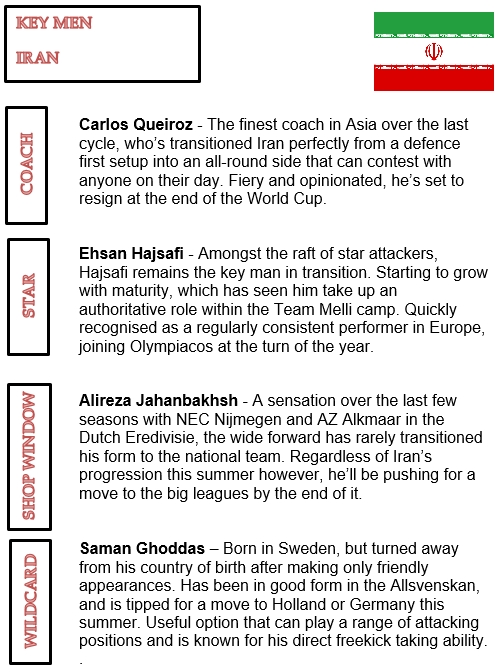
The credit for that defensive strength went to manager Carlos Queiroz, so much so that Asian football pundits have since regularly likened any masterclass of defensive ability, as a sign of the Portuguese coach style - a “Queiroz-esc" performance. The subsequent progression has to be credited likewise, and while Iran only scored 10 goals in as many games in the final stage of qualifying, Queiroz continued to get the best of his attacking players, no one more so than Sardar Azmoun, who since his breakthrough at the Asian Cup in 2015 has scored 22 in 29 appearances for Iran.


Queiroz will modestly point to a raft of attacking options that are simmering up nicely ahead of the World Cup. Alireza Jahanhabakhsh scored 21 goals and assisted a further 14 for AZ in the Eredivisie this last year, while the aforementioned Ghoochannejad (also in Holland) and Ansarifard (now at Olympiacos) have considerably ramped up their careers; scoring 27 over the last two seasons, and 17 in his first full European campaign respectively. 

When Kaveh Rezaei’s name was cut from the provisional World Cup squad last month despite scoring 16 goals in his debut Belgian league season, you’d expect more to be made of it. But given the depth Queiroz has at his disposal it was always going to be difficult to trim down such a selection in attack.

Defensively the options aren’t exactly as plentiful. While Iran have excelled in this regard for the duration of Queiroz’s tenure, the reliance has usually been on sage, safety first centre backs over the next generation of Iranian talent.

That was until the last few weeks, as Queiroz made the surprising decision of leaving the immensely experienced Jalal Hosseini of Iranian champions Persepolis at home. While conspiracy theories ranged from a personal falling out to an on going war of words with Hosseini’s club boss Branko Ivanovic, the public stance has been to bring through new talent.

This opens up arguably the most interesting side plot to Iran’s upcoming World Cup campaign. While focus will be glued to a glut of in form attacking options, Queiroz’s juggling act in defence with a number of inexperienced and largely untested central options could make or break their campaign.

The options at his disposal aren’t what you’d call convincing. Assuming Pejman Montazeri, a journeyman of West Asian football who is steady if not spectacular, is a likely starter, the solution of who to partner him with is widely up for discussion.

Asian Cup hero Morteza Poulaganji is great on his day, but hasn’t hit those 2015 heights for a while due to injury. Rouzbeh Cheshmi is prone to making crucial errors despite his quite considerable talent, while Esteghlal teammate Majid Hosseini, still only 21 is probably considered too much of a risk after only picking up his first cap in the last month.

Their group isn’t exactly a forgiving testing ground for new talent either; Spain and reigning European champions Portugal await alongside Morocco in Group B, making their opening match against the North Africans a win or bust scenario where personnel tinkering isn’t exactly an ideal training opportunity. If any man can gel a new defensive unit though, Queiroz can. His influence and status within Iranian football remains at an all time high, making it more puzzling than ever that he’s revealed he’d be leaving at the end of the World Cup.

Far from it being a celebratory final tour, Queiroz in his typical fiery way took a swipe at an often amateurish Football Federation, who he’s on more than one occasion taken to action and threatened his resignation at the drop of a hat. The IFF have a poor track record of friendly and training camp organisation which has again dominated their run up to the World Cup, with public backing clearly remaining with the coach.

With Iran in such hot form, with a range of options to hand, Queiroz should be wary of believing his hype too early. The last year has been a cake walk, a squad that has been in truth focusing on the World Cup for a lot longer than any nation in Russia. Iran for once are a credible threat, a serious contender to provide an upset; that is if their coach doesn’t overthink it.


Tuesday, 5 June 2018

World Cup 2018: Saudi Arabia (Preview)


Saudi Arabia will return to the pinnacle of international football this summer after a disheartening 12 year absence. Since qualification to Russia back in September however, it’s been far from a smooth preparation. It's been a period of transition and frustration, with injuries, questionable domestic transfers and form, alongside the running through of two managerial changes all racking up to a Green Falcons side that represents a pale imitation of their progression over the last few years.

Qualification for Russia in the first place should be deemed worthy of celebration. Dutchman Bert van Marwijk was appointed back in 2015 after a poor Asian Cup in Australia with the sole target of returning to the World Cup for the first time since Germany in 2006. Within two years, he had succeeded in not only qualification to Russia’s summer showpiece, but he did so with a side that could finally be considered a workable unit, rather than the mere throwing together of individual talents.

Saudi Arabia had been in the doldrums for a while, only one victory from the last two Asian Cup campaigns combined for a nation that had made the final in six of the seven prior editions was a clear indication that they were quickly falling behind the Asian elite.

By no means was it pretty under van Marwijk. Despite finishing qualification as the joint leading scorers (17 of which were racked up early on against Timor-Leste alone) Saudi Arabia were pragmatic in their execution, surrendered possession often and in all honesty rode their luck in key moments. Their success in the final round of qualification was built on an impressive home record, finishing unbeaten in Jeddah, with four clean sheets from five. Conversely away they looked off the speed; failing to clinch victory against any of their top ranked rivals in their sections (including Palestine and UAE in Round 2, Japan, Australia and UAE in Round 3).

They did however come alive in the big moments. When they needed their big players to shine, they stood up to the occasion. Creative hub Nawaf Al-Abed scored three penalties in their first two final round ties against Thailand and Iraq as they laboured past the weakest sides in their group, while wingers Yahya Al-Shehri and Fahad Al-Muwallad clinched winners to force Saudi Arabia over the line at the end of qualification. Rarely did we see a side in full control of a match, instead a team ready to produce their best when it mattered most, a calling card van Marwijk's teams are becoming particularly known for.


It was a surprise then, that van Marwijk was given his marching orders upon qualification for Russia. The Dutchman who was unashamedly averse to living in the Kingdom, previously curtailing a post-match press conference early to catch a flight back to Europe, was now living on borrowed time - the Saudi Football Federation weren’t to be turning a blind eye anymore with the greater attention they’d likely receive upon qualification. It was questionable why van Marwijk was ever sanctioned to reside elsewhere in the first place, however given the arrangement provided results over his tenure, why the SFF all of a sudden noticed an issue seems equally misguided.

Van Marwijk didn’t need to wait long for his next job, being appointed by Australia at the turn of the year, by this stage his former employers had already moved onto their third successive coach, after Edgardo Bauza (into his third national team job within a year) failed to make a positive impact within his brief two months in charge. Deep into World Cup preparations former Chile coach Juan Antonio Pizzi was installed at the helm; a high profile name, with an even greater defined style of play, a polar opposite from the previous regime.

Pizzi’s high pressing, possession style of football is considerably more aesthetic than the conservative brand instilled by van Marwijk (ironically who is now transitioning Australia the opposite way), however it’s proving heavy going thus far to provide a snug fit for the Saudis. After a pretty damning group stage exit with an experimental B-side at this winter’s Gulf Cup in Kuwait, a winless March against Ukraine and Belgium did little to suggest Saudi Arabia can expect to outlast their three group stage matches in Russia.

There are players within the ranks that have the qualities to match Pizzi’s tactical goal; midfielders Salman Al-Faraj and Taisir Al-Jassim are two of the finest possession based players in the Middle East, however there are far more areas of concern than promise. The defence for one, which is often unfairly derided, the three Hawsawis (Osama, Omar and Montaz) in particular are lambasted, yet are a pretty effective set up domestically and regionally. With a higher line however and given greater responsibility to build up possession they are always likely to be found out at the highest level.

Concerns stretch further up field also. Their stars of qualification came from wide areas; Al-Shehri, Al-Abed and Al-Muwallad, all high impact players with quick acceleration, useful for pressing yet, not exactly the type of players you’d want on the ball in transition. Mohammed Al-Sahlawi, who scored more goals (16 in 14 matches) than anyone other than Robert Lewandowski in World Cup qualification is a deadly poacher on his day, but similarly lacks inventiveness when in possession.

It’s looking like another case of Association interference gone wrong then. Unlike much of their regional peers over the last few years, the SFF at least need to be forgiven for attempting to give their side the best possible opportunities. Another failed example being their initially reasonable link up with La Liga to encourage Saudi players to compete in Europe on the run up to the World Cup. In total however, the three players (Al Shehri, Al-Muwallad and Salem Al-Dawsari) that moved to Spain on loan in January only accrued 58 minutes of pitch time.

The cornerstone of Saudi Arabia’s qualification campaign was unity; 20 of the final 23 man squad play for one of Al-Hilal, Al-Ahli or Al-Nassr. Each player knew their role, honed over the course of a career in the Saudi Pro League, which adopts the same style of play. Unlike any other league in Asia, the Saudi top flight is physical, fast paced and to be frank lacking considered play, a perfect breeding ground then for the transition of one ideology to the national team. Now, with players being channeled into La Liga and with a national coach attempting to impose a new philosophy, players are attempting to evolve their outlook at odds with a style they’ve grown up with - all in a relatively short preparatory time-frame.

It’s a transition that is taking it’s time to get off the ground, but there are green shoots being sprung. Saudi Arabia’s performance against Italy in the last week showed a number of players are starting to embrace Pizzi’s high press philosophy. Whether the team can perform as one, over a sustained period is yet to be seen however.

Few if any, even from within the fanatical base of Saudi football predicted Saudi Arabia would come away from Russia with anything to truly boast about. While this would’ve likely been the outlook under van Marwijk also, the style was at least clear from the outset, feeding perfectly into their undeniable underdog status and ability deficit at this level. Under Pizzi the same fans may look on and merely hope to avoid a humiliating spanking akin to their 8-0 defeat to Germany in 2002. A worldwide spotlight against the hosts in the tournament opener presents them with the perfect opportunity to improve on expectations early.


Monday, 4 June 2018

World Cup 2018: Korea Republic (Preview)


In what will be their ninth successive World Cup, Korea Republic are aiming to return to some sort of respectable form on the world stage after recording their worst campaign since 1998 in Brazil four years ago. The subsequent qualification cycle and World Cup tune up has proven however, there’s still plenty of room for improvement.

It was by no surprise that legendary captain turned coach Hong Myung-Bo was sacked in the aftermath of Brazil. South Korea lacked ideas, composure and to be honest individual talent; all adding up to a predictable campaign where they returned home with a solitary point.

Hong’s replacement, former German international Uli Stielike, did more than just steady the ship, going onto to push hosts Australia through to extra time in the following January’s Asian Cup final. The progression was built on defensive solitary, conceding only twice in six games (both in the final), compared to the same number in half as many games in Brazil. At home however, there was an early indication that the style of play wasn’t necessarily to everyone’s tastes.

While results continued unabated through the early stages of qualification, Stielike’s relationship with the media and fan base slowly broke down, culminating in his sacking after a 3-2 reverse in Doha to Qatar left them in a precarious position of missing out on World Cup qualification for the first time in over 35 years.


Stielike’s replacement felt familiar; following Hong’s track record of coaching various Korean youth sides, Shin Tae-Yong, coach of Korea’s recent Olympic and U20 World Cup sides was seen as the safest of short term picks. Two goalless draws inched them over the line bringing to an end a thoroughly forgetful qualification campaign.

Shin’s track record to date has almost solely been under the KFA's wing; his employers can hardly be questioned for not knowing what type of coach they've appointed. Both high profile campaigns he managed ended short of their potential after initially impressive group stages, illustrating what Shin is capable of at his very best (and conversely at his very worst). That being said, a round robin specialist based on previous experience would very much suffice for this senior crop, after progressing only once past the group phase away from their homeland in their history.

While Korea finished World Cup qualification with only one win from five, the Shin effect only kicked in at the end of the year winning the East Asian Cup in Japan. Playing a more typical “Korean” brand of football, with inventiveness and energy in attack, this was a world away from the conservative Stielike days of the previous three years.

That success, is built unsurprisingly around their talisman Son Heung-Min. Four years on from his tears in Sao Paulo, he’s older, wiser and a hell of a better footballer, developing not only into Asia’s leading player, but a credible match winner at the very highest level in Europe. While he got away with it to a certain degree in Brazil where he was still only 21, any team failure in Russia will strongly see criticism fall at his feet.

Son won't be alone in receiving pressure, the question will still be pointed at his supporting cast in Taegurk Warrior red. Hopes were high that we’d see Son link up with attacking midfielder Kwon Chang-Hoon after a sensational season with Dijon in France. An Achilles injury put paid to that chance however, one of many injuries that have plagued this squad over the last few months (first choice left back Kim Jin-Su and Crystal Palace's Lee Chung-Yong, the latest duo to pull out of the squad reckoning.)

For every closed door, comes an opportunity for another to open. In steps Lee Seung-Woo, a long time tipped, heir to Son in many ways. After a seemingly never ending stint in the Barcelona youth ranks followed by a move away to Italy, all seemed to go quiet on the young Korean’s career, that is until this last month.

A stunning goal against AC Milan at the start of May, followed by a first senior call up in Shin’s provisional World Cup squad and a positive debut against Honduras to boot - Korean fans are already lining him up as their next best attacking option. He’s proven at youth level, most notably at last year’s home U20 World Cup under Shin, but he’s by and large an unknown package at senior level. Something that may play into his and Korea's hands.

Their chances will also depend on the manager’s tactical choices. Kwon’s injury has seen their preferred set up thrown out, bringing to the fore a number of last minute tinkerings that have had mixed results in the past few weeks; including a forward heavy 442 deployed against Honduras and a makeshift 352 against Bosnia.

Initially it looks like a case of fitting square pegs in round holes. The casualty list has created openings with few capable options to fill them. Captain Ki Seung-Yueng, the side's creative hub was unsuccessfully trialed at centre back against Bosnia, while East Asia’s brightest domestic star Lee Jae-Sung may be forced to play deeper to compensate a shift in system.

The philosophy at least will start on a positive footing, and so it should be; aside from Germany, a group including Sweden and Mexico is favourable in comparison to most. Having an in form Son, flanked with willing interplay and there is as good a chance as any of progression. The issue remains in their delivery, something Korean fans on the build up to Russia are questioning Shin regularly over.


Monday, 8 January 2018

Intermission


After a few years of regular World Cup qualification and AFC Champions League posts, I’ve decided to take a break from updating the blog. I’ll likely return on the run up to Russia with a few previews, but will resume with my normal round previews/reviews in a year’s time when the Asian Cup takes place in the UAE. 

Thank you to everyone who has supported my blog to date. See you then!

Friday, 8 September 2017

WC Qualifying Review (Round 3 MD9 & 10)


It’s been a lengthy process, but two and a half years later from once we began, we have finished the automatic stage of Asian World Cup qualification. Japan, Korea Republic and Saudi Arabia joined Iran as Asia’s four guaranteed representatives in Russia next summer, while we have yet another tangible chance of representation with outsiders Syria joining Australia in the playoff rounds before the year is out. For much of the predictability that had come before, September’s batch of qualifiers were a feast for the eyes, here’s my look back at the winners and losers from the week.

The Player

Arguably the longest reaching story of this round of World Cup qualification has been Syria’s progress over the campaign. Despite being tipped to perform by Asian football fans back in 2015, I doubt few of us who made such claims thought they’d ever have a realistic shot at a place in Russia, which they have now engineered themselves with an appearance in the WCQ playoffs. Critics may question their style of play, but their dogged defensive tactics were given a reboot this last week, scoring more than 1 away from home for the first time (breaking a previously impenetrable Iran defence twice) while recording their first non-1-0 win of the stage with a 3-1 win against Qatar on Thursday.

One player’s return can be attributed to their improved fortunes in attack, that of Omar Al-Somah. The hottest striker in the Middle East, Al-Somah’s refusal to accept a call up for Syria were well known, but over the summer the enticing news spread that a return was imminent. In his first two appearances in Syrian red, his presence was instantly felt; the team could set up with a focal point which could help the ball stick. Shifting previous lone frontman Omar Khribin out wide worked wonders (scoring the first two against Qatar), while Al-Somah’s threat was sometimes too much to ignore even when he hadn’t got the ball (see Al-Mawas’ poorly defended goal to end that match).

Al-Somah proved his goalscoring threat away at the Azadi, against the best side in Asia, who hadn’t been breached in this round of qualification. A trademark Ronaldo-esc free kick was too hot to handle for Iranian keeper Beiranvand, slipping it to Khribin for the opener, while his last minute leveller sparked scenes of delirium from the bench as Syria ensured progression. There’s a long way to go yet, with Australia followed by an intercontinental playoff (possibly with a headline grabbing encounter against USA) to come, but with Al-Somah now leading the hunt in attack, this is far from the cautious Syrian side that started qualification.

The Team

When Bert van Marwijk took the reigns of the Saudi Arabia national team at the start of qualifying in 2015, I amongst many were admittedly skeptical of his ability to stabilise a notoriously difficult yet talented set of players to compete with the likes of Japan and Australia for a return to the World Cup after XX years away. In the end I was proven spectacularly wrong, with van Marwijk harnessing the true qualities of his squad to clinch qualification in the last match of the series, beating Japan in Jeddah on Tuesday.

After a stuttering start to the final stage of qualification, Saudi bubbled under the radar for much of this campaign, many assuming they wouldn’t be able to keep up their ominous run of form that clawed them over the line. Aside from the undoubted team effort and tactical masterclass from their Dutch coach there were more than the odd player who stood up and rose to the occasion.

Nawaf Al-Abed morphed from flamboyant but erratic playmaker into clinical match winner, scoring X amount of goals and crucially laying on the winner against Japan. Fahad Al-Muwallad, that historic goalscorer has started to live up to his undoubted potential, while defensively Al-Hilal stalwarts Salman Al-Faraj and Osama Hawsawi have taken responsibility, when before they often crumbled. Surely the Hawsawi badge of calamity can now be retired?

A year of euphoria and pride is to come as we inch towards Russia and a historic return for the Green Falcons. While some Asian fans will take this as just reward for van Marwijk and the national team, pressure will again be undoubtedly be on them from their home support to contest at the highest level. While on paper their squad is a notch below that of what they can hope to compete with, you wouldn’t count out Al-Abed and co to grasp their chance of a life time at next year’s grandest stage.

The Talking Point

Going into the final fixture goal difference was always likely to play a huge part in who would join Japan from Group A at next summer’s World Cup, yet after being billed as a cricket score chasing encounter, Australia frustrated attempts to thrash Thailand came up against a stubborn defence and inspirational keeper display. X amount of shots only materialised 1 goal, leaving Saudi Arabia in the knowledge a win of any kind at home would guarantee them a place in Russia, a task they obliged.

As continental champions, with the most expensive squad in Asia, playing some of the most eye catching tactical football around, with a reputable coach to boot, there can’t be any sugar coating of the fact, that not qualifying for the World Cup at the first attempt is a failure. Of course the playoff route offers up a second chance saloon for Ange Postecoglou, entering his final period as Socceroo coach before he presumably lands a job in Europe, with Syria and a potential 4th placed CONCACAF side to come.

The question marks surrounding their campaign have surrounded a number of deficiencies; scoring from open play (albeit this has been greatly improved upon), a reliance on the outgoing Tim Cahill (who looks to be finally phased out as a starter) and some pretty ineffectual away form. They remain as stated previously, the best side to watch in Asia, as this summer's Confederations Cup performances can prove witness to, however results continue to not come hand in hand (x points from three games in Russia).

Ahead of this final round of matches, I proposed it better for Asian football that Saudi Arabia progress automatically ahead of Australia in the Race of Russia, not out of any particular bias (if so I’d argue the other way if anything) but Australia’s greater capability to qualify against stiff North American opposition. Whether I’m swayed by the aesthetically pleasing approach from Postecoglou over van Marwijk’s more pragmatic direct thrust I’m beginning to wonder; either way I got my wish and we’ll be set for yet another set of defining matches in the Greek born coaches career.

Wednesday, 28 June 2017

Confederations Cup 2017 (SFG Coverage)


The Confederations Cup offered us a glimpse at what we can expect in 12 months time, once we return to Russia for the World Cup 2018. Australia’s performance was keenly observed given their current struggles to qualify for next year’s tournament and they didn’t disappoint. Despite failing to engineer a successful path through to the knockout stages, Australia’s much maligned formation shift to 3241 seemed to be gaining momentum by the time they headed home, with a highly impressive performance against Chile in their third match of the tournament.

With key World Cup qualifiers to come in the next two months against Japan and Thailand, only progression at the first time of asking to Russia 2018 will satisfy the Socceroo faithful. In the meantime I looked back with Tom Danicek on an up and down Confederations Cup campaign for Australia.

Australia’s Confederations Cup takeaways

Wednesday, 14 June 2017

WC Qualifying Review (Round 3 MD8)


June’s round of World Cup qualifiers was pretty eventful, despite only having one match day. A number of off-the-field talking points were circling in the run up and post-match discussions; from Saudi Arabia’s stance on honouring minute silences, the same country’s political relationship with Qatar, not to mention the round being played during Ramadan at the peak of summer, in conditions FIFA have unequivocally categorised as unplayable; there was a lot to contend with. The football on offer did produce drama (Syria’s late equaliser, Qatar’s victory over Korea) but quality from the big boys remained thin on the ground. That is aside from Iran, who become Asia’s first representation in Russia 2018. Congratulations to them, but a case of improvement is needed for the rest.

The Player

If there ever was a time to call upon your leading man, Thursday was that occasion. Up against a fired up attacking Saudi Arabia side, resisting with a wobbly defence, Australia needed goals, something that have come before but mainly through predictable channels; headers off set plays, penalties and of course the legendary Tim Cahill. Tomi Juric, who had been leading the line pretty well over the last few games, finally got the lucky break he needed in front of goal, notching a brace in arguably his finest appearance in a Socceroo jersey.

That break came early, but still asked much of Juric’s ability to quickly turn a half chance into a goal-scoring opportunity. Saudi keeper Yassr Al-Mosailem’s wayward drop kick failed to reach 20 yards, demanding an instant control then volley from Juric to fire Australia into an early lead. Pegged back quickly, Juric was called upon again; this time Matt Leckie aided the physical striker, skipping down the line before cutting back the cross for Juric to head home. While Juric went close to securing his hat-trick late on, it was his all round hold up play that again impressed in the second period.

Juric’s place in the Australian XI has at times been an uncomfortable fit, but it’s now unequivocally been cemented over the last few months. Injury setbacks at the end of last year held him back, while Tim Cahill continued to be a thorn off the bench. With Juric coming into form at the end of the league season with Swiss side Luzern (scoring 3 in 3 to finish the campaign), alongside Cahill’s dip in form due to age, the spotlight shifts to a career highlight of leading the line in Russia for the Confederations Cup. Can he continue in his rich vein of form?

The Team

Carlos Queiroz made history on Monday night, becoming the first coach of Iran to guide the Persian Leopards to back-to-back World Cups. They did this in invincible style, going unbeaten in the final round of qualifiers, while keeping their sheets clean competitively since November 2015. While the quality of their opponents has considerably dropped in the last year, Iran’s performances keep improving, both tactically and personally they’re proving a force to be hold.

Queiroz’s defence first stance was understandable early on, without the correct attacking talent to really contest continentally, let alone on the world stage, as was seen in Brazil in 2014. A new breed of talent, headed by the precocious Sardar Azmoun (who opened the scoring on Monday) puts their attacking threat right up there with anyone in the region. Flanked by Alireza Jahanbakhsh, a player who may make another step up domestically in the summer, and Mehdi Taremi, who scored his 3rd in as many qualifiers against Uzbekistan, there’s youth and pace in a side that once was all about solidity.

So, how far can Iran go? They can’t complain that they haven’t had time, the writing’s been on the wall for months, and now that we sit exactly 1 year away from Russia, it should give them the appropriate time for a solid period of preparation. That’s one word that has often been misused by IFF and Queiroz in tandem; oddly timed domestic-only training camps have often proved divisive, while friendlies against worthwhile opponents have been difficult to arrange. The next 12 months will be priceless, but given their strong standpoint, every Asian football fan is looking forward to the end result.

The Talking Point

Maybe it’s just me, or have I missed the period when Uzbekistan were actually on form? As it stands they’re 1 point behind Korea Republic in Group B, 1 point away from the holy grail which is World Cup qualification. With only 1 win in their last 4, their form has at least been missing this calendar year, but looking back on the start of their campaign, has it ever been more than a lucky victory here and there, deployed from broadly men behind the ball tactics.

In March, I stated that Uzbekistan wouldn't qualify for Russia 2018, after an awful performance in Melaka, going down to nearest rivals Syria, before an undeserved 1-0 home win over Qatar. Now, when I said this I assumed even if they weren’t caught by Syria/Qatar/China below them, they would be out of contention in the playoff system; Saudi Arabia/Australia followed by USA would be far too much for this side. A few months down the line, little has changed, Uzbekistan are still awful, but side’s around them (including Korea ahead of them) seem to be throwing them a line.

Their final two matches; away in China followed by a home tie with Korea should be on current performances too much to catch the latter in home of the automatic places. With South Korea hosting Iran first off however, who knows what could happen by the beginning of September, Uzbekistan could well be representing Asia after all! I’ve long been a fan of Uzbekistan, but while a last minute wobble used to put them off the final hurdle, this time the system and confidence instilled by Samvel Babyan is dragging the team down. I’ll stand by my statement that Uzbekistan can’t qualify for Russia, with one amendment - unless they sack Babayan over the summer.