Showing posts with label Iran. Show all posts

Wednesday, 30 January 2019

Asian Cup Matchday Review (Semi-Finals)


We’re now left with our final two, as Japan and Qatar overcame favourites Iran and hosts UAE in Monday & Tuesday’s semi-finals. While we’ve had hiccups along the way, it can’t be argued that we haven’t been granted the best two tactical teams on current form ahead of Friday’s final. Moriyasu’s Japan have grown into this tournament and demonstrated the best half of football we’ve seen in Asia for years, while Sanchez’s Qatar brushed aside the hosts as an afterthought, after a heated “blockade derby” ended with one clear winner. Looking back on the round, here’s my take on the key talking points.

The Player

“Flat track bully turned big match hero.” Depending on your point of view I may have undersold Almoez Ali’s impact to date there. The languid frame of Qatar’s leading man often flatters to deceive, but on this tournament’s reading, the Sudanese born striker has proved you shouldn’t underestimate his proficiency in front of goal. As Qatar emphatically overcame UAE in Tuesday’s semi-final, Ali clinched a little bit of history of his own, scoring his 8th in 6 matches, matching that of Asian great Ali Daei, in become the joint highest goal scorer in a single Asian Cup campaign.

In previous matches, Ali has come alive in the most inopportune moments, in jumping on lapses in defending, off a brilliant assist or dropped ball to capitalise in devastating fashion. His strike to double Qatar’s lead over the hosts was noticeable in its variance from the usual trend; picking up the ball 30 yards out, he engineered a small amount of space, to curl past the outstretched Khalid Eisa and send the capacity crowd into rapturous boos and sandal throwing petulance. The way he used the defender to create the angle was ingenious, the finish was right up there with the best at this tournament.

Ali’s career has blossomed of late, not in terms of proficiency, as he’s always been known for a high strike rate from early youth, but in his technical development. Having been moved out wide domestically for Al-Duhail, his movement and link up play have come along in spades, and that has transitioned into the national team. His passion for the cause also has been noticeable, for an often-quiet looking man, he’s been the most emotional of performers in the key politically charged moments against Saudi Arabia and UAE. Ahead of the final, Ali will be out to make history on a personal as well as national platform.

The Team

In the biggest match of the tournament so far, the best side in Asia over the last four years collapsed to their first continental competitive defeat over that time in dramatic style. While much of the discussion after the match surrounded Iran (I will get onto that), and where they go to now, Japan deserve the lion share of the limelight after what was another well thought out game plan. After a wobbly group stage, which required a comeback against Turkmenistan and a ground out result against Oman, the evolution of this Samurai Blue side has been a credit to their coach Hajime Moriyasu. After coming into the Asian Cup in muted form, Japan stand with one hand on the trophy ahead of Friday’s final with Qatar.

The Turkmenistan opener that welcomed this new Japanese side into competitive football, minus the likes of Keisuke Honda, Shinji Kagawa and Shinji Okazaki to name a few for the first time, was a tad disappointing to say the least. Defensively they were caught off guard too easily on the transition, whilst in possession they lacked ideas. From there forward, Japan improved immensely, firstly in a defensive capacity; their narrow victory over Saudi Arabia in the knockouts was a prime example of how to restrict attacking output to a possession hungry opposition, but they also improved their own forward thrust, demonstrated fully on Iran.

It’s arguably been slow in the uptake, but off the back of an improved performance by Ritsu Doan against Vietnam, the first-choice front four were back clicking. The return from injury of Yuya Osako spearheaded this, combining beautifully with Minamino (who looks much more comfortable in a support role opposed to burdening the goal scoring responsibilities) for both his opener, and the resulting penalty. Genki Haraguchi, one of the few who to survive the transition from direct countering deployed under the previous Halilhodzic regime, has changed up his game and capped off his performance with the late third.

For all the youthful inventiveness that has come to the fore, it was in experienced deeper areas where Japan starred most against Iran however. Maya Yoshida has grown in his responsibility, given the likes of Makoto Hasebe and Keisuke Honda have left. He looked a taller man, leading from the back alongside his fledgling defensive partner in Tomiyasu, his regal status is beginning to blossom. Another muted but effective performance from Gaku Shibasaki again ticked the team along. When few were keeping their heads in the Iranian line-up, Shibasaki ran the show coolly.

This new breed of Japan under Moriyasu has taken time to get used to, but with Iran joining the likes of Saudi Arabia, South Korea and Australia on the plane home after underwhelming campaigns (most of whom remain in transition), Japan’s success to date is ever more considerable. A Friday final appearance awaits them, as Japan continue to flex their undoubted muscle on the continental stage.

The Talking Point

Monday’s exit for Iran from the Asian Cup, which many had them destined to win, left many with a mixture of feelings. For neutrals, for an overwhelming favourite to be contested in that way is uplifting, however given the manner of the capitulation and resulting fallout, the last four years of dominance has a feeling of anti-climax for most of us. In the direct wake, legendary head coach Carlos Queiroz leaves Iran, having overseen arguably the greatest national side in the country’s history, but he still leaves plenty of what ifs.

As suggested in my tournament preview, Iran’s Achilles heel was that of mentality, something Queiroz had developed over his tenure. At the World Cup last summer, Iran revelled in being the underdog, contesting with the likes of Portugal and Spain on a technical level was a tough ask, but on an emotion level they had it won hands down. When it comes to continental football however, Iran were rarely going to be afforded such little expectation. The second half in particular against Japan finally ebbed away from them, fuelled by a sense of injustice where emotion and spirit overcame them, to be clinically took apart by a ruthlessly put together Japan side.

It's difficult to separate Queiroz’s managerial style and Iran’s philosophy, as both seem to fuel each other. Where to next for both parties will be very interesting indeed, and whether either will differ intact. While Queiroz is rumoured to be heading to South America, with Colombia being the most interested of parties, Iran start afresh in their pursuit of replacing a living legend. An emotional resilient approach has worked wonders the last four years, but given the improvements made in Iranian football from a talent perspective, is a technical, forward thinking coach the way to go? With Juan Antonio Pizzi already being muted as a potential successor, Iranian fans could be set to replace chalk with cheese on the most extreme proportions.

Wednesday, 9 January 2019

Asian Cup Matchday Review (Group Stage GW1)


The Asian Cup kicked off last weekend in impressive style, with a great mix of convincing performances, underdog shocks and some good old fashioned terrible defending on show. Despite some disappointing attendances at many of the matches, some of the football offers hope we are about to see a competitive stage going forward, while the underachievement of some of the big guns alludes to a greater consistency of play across the continent. Summing up the first week of action, I’ve picked out a player, team and talking point for further focus.

The Player

The devastating news on the eve of their Asian Cup opener that star midfielder Salman Al-Faraj was ruled out of the entire tournament, was a hard blow to take for Saudi Arabian fans, but one that might have been eased by the evolution of a new centre midfield partnership. Al-Faisaly midfielder Abdulaziz Al-Bishi, who has slowly become a regular at the heart of the midfield in the last few months, had a stand out performance alongside Abdullah Otayf in the fulcrum of the Green Falcons set up against North Korea, complemented perfectly with two assists in their 4-0 victory.

It perfectly summed up his impact, that Al-Faraj wasn’t really missed at all. Otayf, continuing his World Cup form, of industrious, tireless play in front of the back four, Al-Bishi dictated play off his diminutive partner, roaming around the centre of the park, quick to create and intuitive in his movement. A quick pass out to the left stretched the North Korean defence, to allow Hatem Bahebri to cut in and open the scoring, while a direct inside run caught the opposition napping once again, allowing Al-Bishi to cut back for Al-Dawsari to clinch a third goal. It was a low-key performance on the face of it, but it allowed others to shine.

His progression to date has been slow, but after his summer move from Al-Shabab, Al-Bishi has subsequently nailed down domestic starts, was integral in Saudi Arabia’s Asian Games run, whilst continually impressing for the seniors since. While Saudi Arabia’s 4-0 win on paper looks to headline a side in promising form, there are plenty of questions still to be asked at both ends of the pitch. Al-Bishi’s form of late however, ensures the centre third remains the Kingdom’s most prized asset.

The Team

With Australia, South Korea and Japan all experiencing varying degrees of scares in the first round of matches, pre-tournament favourites Iran shrugged off the pressure in a crushing 5-0 victory over Yemen. While the performance may have been aided in their opposition’s collapse (after an initially promising first 10 minutes), Iran forced their hand, demonstrating some eye-catching attacking fluidity, dynamic midfield play and generally a positive attitude that some (me included) doubted of them ahead of the tournament.

Support striker Mehdi Taremi headlined the performance with a first half brace illustrating his importance to Team Melli; first he reacted quickest off a keeper spillage to slot home, secondly a perfectly directed header from distance. On paper he’s rarely been seen as an eye-catching option but offers much more than the sum of his parts. His link up play with Sardar Azmoun, and the highly effective Mehdi Torabi, who stepped up in place of the injured Alireza Jahanbakhsh was an aspect to saviour, and something they’ll undoubtedly need to rely upon going forward.

Further back apart from the initial scare, Iran defended as Iran do under Carlos Queiroz, an area they’ll continue to excel going deeper into the tournament. The recall and subsequent performance of Ashkan Dejagah gave further hope that depth will also be key over the next month. His initiative and speed in transition helped Iran tick over and threaten Yemen’s napping defence, while his freekick (which inexplicably hasn't been chalked down as a goalkeeping own goal) was the cherry on top of his individual display. Plenty to be pleased about, as Iran march on ominously.

The Talking Point

Ever since the draw was made, and with the expansion to 24 teams allowing more inexperienced and weaker sides to enter the tournament, few shocks were predicted in the opening rounds, yet we’ve already been treated to a number. UAE struggled in their opener against Bahrain, having to rely upon questionable officiating to secure a draw, reigning champions Australia were stung by a well drilled counter display by Jordan, Southeast Asian heavyweights Thailand were crushed by India, all while the likes of China, Korea and Japan all looked shaky before forcing victories over the line.

It led to some to dig into the reasons why this was the case. Some suggested it was tactics; sides with less possession hitting opposition on the counter surely had a greater say early on, while it could be considered a condensing of the pack thanks to the new and more strenuous international calendar could’ve provided closer fought contests. But for the eventual result, the likes of Philippines, Turkmenistan and Kyrgyzstan all put in competent displays, when few really gave them much hope in the tournament’s build-up.

In the end, Iran and Saudi Arabia’s dominant performances to end the week suggest a lack of familiarity in the dugout may have damaged those elite nations more than them merely being caught off guard. New coaches in charge of Australia, Korea and Japan clearly have further work to achieve in finalising their state of play, while a severe lack of form going into the Asian Cup for China, Thailand and hosts UAE meant few should’ve expected a tournament bounce from the get go. Given third in the group allows progression, there’s a long way to go to be sure of a big shock exit or two, but for now it makes for fascinating viewing.

Monday, 17 December 2018

Asian Cup 2019: Iran (Preview)


By far and away the strongest team in Asia over the last four years, Iran illustrated perfectly their combination of tactical discipline and attacking talent on the world stage in Russia earlier this year. With the pressure off, they defied the odds and won around the neutrals, but now that they enter the tournament arena in high regard and under increasing pressure, can they lead the pack as Asian Cup favourites?

Times have changed in Iranian football. Up until recently, a tight defence, and an organised but unspectacular attacking game was a given from the national side. While we saw green shoots appearing four years ago at the Asian Cup in Australia, nothing could have prepared us for the depth in quality Iran took to Russia over the summer. Only a goal or a stroke of luck stood in their way of making history in progressing out of the group phase at the World Cup, in a section that included former champions Spain and current European champions Portugal no less.

The performances in themselves, balanced alongside Asia’s best performing World Cup to date, were at a level above what we’d ever seen before. A side, out thinking, out running and at times out playing top quality European players was a delight to have witnessed. From the highest peak of this current generation’s playing days, an Asian Cup falls straight off the back of their World Cup adventure, a tournament lead-up that has dubbed them as kings in waiting before a ball has even been kicked.

Throughout qualification, it’s to be said, they lived up to the expectation and their considerable favourites tag. Iran went 18 matches unbeaten, keeping 12 clean sheets in a row, to qualify seven points clear of second placed South Korea. Put simply, they obliterated the opposition, only dropping points on four occasions, finishing with a total of 40 points from a possible 48, as they sealed qualification with two games to spare.

Their success owed to both their past and future styles of play. Defensively they were incredible, organised perfectly in the mould of their manager Carlos Queiroz. As the World Cup demonstrated, irrespective of their personnel, the Team Melli defensive stamp is clear and unassuming. The key development however was linking this with their attack; the consistency of Sardar Azmoun, leading the line, the direct running of Alireza Jahanbakhsh, and the flexibility of Mahdi Taremi, all making for a multi-faceted front three, that sparked fear into any opposition they faced.


Over the last year, the additions of Saman Ghoddos, who’s started on top form since moving to France, Ali Gholizadah, a player already recording a goal every other game for his country and Kaveh Rezaei, now competing regularly in the European Champions League, illustrates the strength in depth Queiroz has to play with, and what firepower is set to be unleashed at the Asian Cup.

Picking holes in Iran’s on the pitch displays, is a difficult ask, any side that has only tasted defeat once (to Spain, of all teams) in a competitive environment since the last Asian Cup, is a side showing little weakness continentally. The concerns, as has regularly been the case, is in their off the field matters. The IFF had shown signs of change during qualification, only for it to be thrown back up for debate, upon their run up to the World Cup.

National team camps are regularly a mess in their organisation, friendlies treated as an afterthought (behind closed doors matchups and facing off against Sierra Leone ‘B’ for example), while their ongoing public war of words with manager Carlos Queiroz (who incidentally said he was leaving the managerial hot seat upon conclusion of the World Cup, for the nth time) is constantly burning a wedge at the heart of Iranian football. Captain Masoud Shojaei’s comments in November, calling out the ineptitude of the powers that be, was another nail in the coffin of the already unpopular Iranian hierarchy.

On the eve of this continental showpiece, with a squad that has the best opportunity of clinching their first final appearance since their home victory in 1976, a unified force from the top down would have seemed the logical starting point, but with Iranian football when is it ever that simple? 

A smooth run in has rarely been necessary however, cases such as Sardar Azmoun’s return from early retirement, seen as the norm, and that signifies an important point; Iran succeed when they are forced into a corner.

How the game pans out on the pitch, will see them have to adjust accordingly. Once we enter the knockouts, teams will adapt and look to draw out Iran’s underdog spirit, which could prove to be a deficiency, given the array of talent they have to offer. Tactically Queiroz has continually shown that he’s able to strike the right balance on the big occasion, yet their quarter final exit to Iraq in 2015 will still weigh heavily in his mind, as a case of what could’ve been.

Destiny is set to be retold, as Iran face Iraq in their final group stage encounter in the UAE. By that point, it could prove irrelevant for both sides, but may offer the earliest of indications of how this Iranian side sets itself apart from the higher quality sides in the competition. Tasked with overthrowing the likes of Australia, Japan and South Korea, it might come down to the mood of the squad, rather than the impressive form. An emotional task, to pin to an already emotional coach, leading to the pinnacle of what has been a quite scintillating four years.

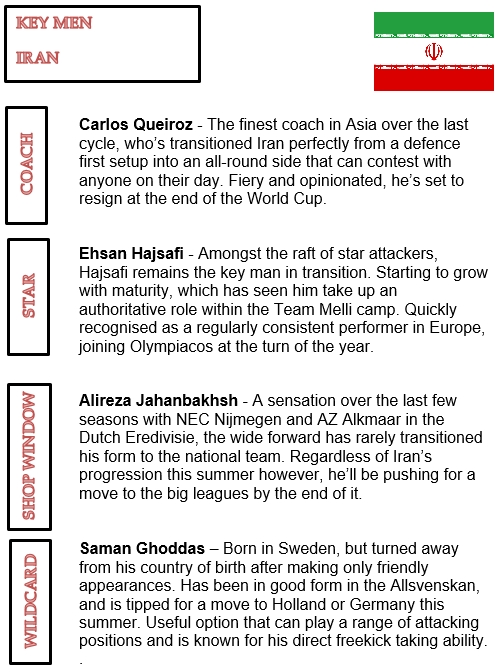
Key Men

Head Coach - Carlos Queiroz (POR)

Outspoken, tactical expert who has been at the forefront of Iran’s rise over the last 5 years. Initially formed a technically deficient side, into a team that was incredibly hard to beat. With the emergence of attacking talent, Queiroz has maximised their impact at both ends of the pitch. Infamous for handing in his resignation, only to go back on his word on several occasions.

Star Player - Morteza Pouraliganji

After an imperious World Cup, the central defender aims to do what few have done before him, in having three stand out tournaments in a row. The move to Europe for the first time in his career can only assist his already varied game, the 26-year-old alongside his younger colleague Majid Hosseini, look to have established the centre back partnership for the future of the national team.

Under Pressure - Ramin Rezaeian

A revelation in World Cup qualification, followed by stalled domestic transfer to Europe and a limp return to Asia has left him a divisive figure in terms of the Team Melli reckoning. Often unpredictable and capable of the brilliant in attacking areas but can be caught out defensively. Competition at full back, looks to have displaced him as a back four regular ahead of the Asian Cup.

Young Prospect - Ali Gholizadeh

In hindsight, he would’ve been a useful substitute option in Russia, but the 22-year-old has raised his game further than anyone in Iranian squad since the summer. Quick and direct, the Charleroi man can feature anywhere down the left flank, being used in a more attacking capacity most recently by Queiroz, opening his Team Melli account officially in November.

Wednesday, 6 June 2018

World Cup 2018: Iran (Preview)


Four years is a remarkably long time in football. Anyone who endured Iran’s goalless opener against Nigeria in Brazil, 2014 couldn't have imagined the transformation that was to come. From a solid but offensively feeble unit with only a handful of players playing top level European football, to a squad blossoming with some of the most sought after talent around, Iran have gone from strength to strength, while others in Asia continue to lag behind.

Iran’s record in qualifying was nothing short of dominant. While their rivals regularly slipped up, Iran steamrolled through all in their wake. They went 18 matches unbeaten, keeping 12 clean sheets in a row, qualifying seven points clear of second placed South Korea.

The standard of play over the cycle has considerably increased. Iran’s portrayal in Brazil was rightly seen as a roadblock in front of their own goal, lacking any inventiveness going forward. Having to rely on the likes of Reza Ghoochannejhad (then struggling for game time at Charlton Athletic in the English second tier) and Karim Ansarifard (still plying his trade in Iran) to find the goals was always going to provide slim pickings. Ambitions were expectantly low, and despite only collecting one point from three matches, Iran headed home proud of their defensive resistance; peaking against Argentina, where they held out until a last minute piece of Lionel Messi magic broke the deadlock.

The credit for that defensive strength went to manager Carlos Queiroz, so much so that Asian football pundits have since regularly likened any masterclass of defensive ability, as a sign of the Portuguese coach style - a “Queiroz-esc" performance. The subsequent progression has to be credited likewise, and while Iran only scored 10 goals in as many games in the final stage of qualifying, Queiroz continued to get the best of his attacking players, no one more so than Sardar Azmoun, who since his breakthrough at the Asian Cup in 2015 has scored 22 in 29 appearances for Iran.


Queiroz will modestly point to a raft of attacking options that are simmering up nicely ahead of the World Cup. Alireza Jahanhabakhsh scored 21 goals and assisted a further 14 for AZ in the Eredivisie this last year, while the aforementioned Ghoochannejad (also in Holland) and Ansarifard (now at Olympiacos) have considerably ramped up their careers; scoring 27 over the last two seasons, and 17 in his first full European campaign respectively. 

When Kaveh Rezaei’s name was cut from the provisional World Cup squad last month despite scoring 16 goals in his debut Belgian league season, you’d expect more to be made of it. But given the depth Queiroz has at his disposal it was always going to be difficult to trim down such a selection in attack.

Defensively the options aren’t exactly as plentiful. While Iran have excelled in this regard for the duration of Queiroz’s tenure, the reliance has usually been on sage, safety first centre backs over the next generation of Iranian talent.

That was until the last few weeks, as Queiroz made the surprising decision of leaving the immensely experienced Jalal Hosseini of Iranian champions Persepolis at home. While conspiracy theories ranged from a personal falling out to an on going war of words with Hosseini’s club boss Branko Ivanovic, the public stance has been to bring through new talent.

This opens up arguably the most interesting side plot to Iran’s upcoming World Cup campaign. While focus will be glued to a glut of in form attacking options, Queiroz’s juggling act in defence with a number of inexperienced and largely untested central options could make or break their campaign.

The options at his disposal aren’t what you’d call convincing. Assuming Pejman Montazeri, a journeyman of West Asian football who is steady if not spectacular, is a likely starter, the solution of who to partner him with is widely up for discussion.

Asian Cup hero Morteza Poulaganji is great on his day, but hasn’t hit those 2015 heights for a while due to injury. Rouzbeh Cheshmi is prone to making crucial errors despite his quite considerable talent, while Esteghlal teammate Majid Hosseini, still only 21 is probably considered too much of a risk after only picking up his first cap in the last month.

Their group isn’t exactly a forgiving testing ground for new talent either; Spain and reigning European champions Portugal await alongside Morocco in Group B, making their opening match against the North Africans a win or bust scenario where personnel tinkering isn’t exactly an ideal training opportunity. If any man can gel a new defensive unit though, Queiroz can. His influence and status within Iranian football remains at an all time high, making it more puzzling than ever that he’s revealed he’d be leaving at the end of the World Cup.

Far from it being a celebratory final tour, Queiroz in his typical fiery way took a swipe at an often amateurish Football Federation, who he’s on more than one occasion taken to action and threatened his resignation at the drop of a hat. The IFF have a poor track record of friendly and training camp organisation which has again dominated their run up to the World Cup, with public backing clearly remaining with the coach.

With Iran in such hot form, with a range of options to hand, Queiroz should be wary of believing his hype too early. The last year has been a cake walk, a squad that has been in truth focusing on the World Cup for a lot longer than any nation in Russia. Iran for once are a credible threat, a serious contender to provide an upset; that is if their coach doesn’t overthink it.


Wednesday, 14 June 2017

WC Qualifying Review (Round 3 MD8)


June’s round of World Cup qualifiers was pretty eventful, despite only having one match day. A number of off-the-field talking points were circling in the run up and post-match discussions; from Saudi Arabia’s stance on honouring minute silences, the same country’s political relationship with Qatar, not to mention the round being played during Ramadan at the peak of summer, in conditions FIFA have unequivocally categorised as unplayable; there was a lot to contend with. The football on offer did produce drama (Syria’s late equaliser, Qatar’s victory over Korea) but quality from the big boys remained thin on the ground. That is aside from Iran, who become Asia’s first representation in Russia 2018. Congratulations to them, but a case of improvement is needed for the rest.

The Player

If there ever was a time to call upon your leading man, Thursday was that occasion. Up against a fired up attacking Saudi Arabia side, resisting with a wobbly defence, Australia needed goals, something that have come before but mainly through predictable channels; headers off set plays, penalties and of course the legendary Tim Cahill. Tomi Juric, who had been leading the line pretty well over the last few games, finally got the lucky break he needed in front of goal, notching a brace in arguably his finest appearance in a Socceroo jersey.

That break came early, but still asked much of Juric’s ability to quickly turn a half chance into a goal-scoring opportunity. Saudi keeper Yassr Al-Mosailem’s wayward drop kick failed to reach 20 yards, demanding an instant control then volley from Juric to fire Australia into an early lead. Pegged back quickly, Juric was called upon again; this time Matt Leckie aided the physical striker, skipping down the line before cutting back the cross for Juric to head home. While Juric went close to securing his hat-trick late on, it was his all round hold up play that again impressed in the second period.

Juric’s place in the Australian XI has at times been an uncomfortable fit, but it’s now unequivocally been cemented over the last few months. Injury setbacks at the end of last year held him back, while Tim Cahill continued to be a thorn off the bench. With Juric coming into form at the end of the league season with Swiss side Luzern (scoring 3 in 3 to finish the campaign), alongside Cahill’s dip in form due to age, the spotlight shifts to a career highlight of leading the line in Russia for the Confederations Cup. Can he continue in his rich vein of form?

The Team

Carlos Queiroz made history on Monday night, becoming the first coach of Iran to guide the Persian Leopards to back-to-back World Cups. They did this in invincible style, going unbeaten in the final round of qualifiers, while keeping their sheets clean competitively since November 2015. While the quality of their opponents has considerably dropped in the last year, Iran’s performances keep improving, both tactically and personally they’re proving a force to be hold.

Queiroz’s defence first stance was understandable early on, without the correct attacking talent to really contest continentally, let alone on the world stage, as was seen in Brazil in 2014. A new breed of talent, headed by the precocious Sardar Azmoun (who opened the scoring on Monday) puts their attacking threat right up there with anyone in the region. Flanked by Alireza Jahanbakhsh, a player who may make another step up domestically in the summer, and Mehdi Taremi, who scored his 3rd in as many qualifiers against Uzbekistan, there’s youth and pace in a side that once was all about solidity.

So, how far can Iran go? They can’t complain that they haven’t had time, the writing’s been on the wall for months, and now that we sit exactly 1 year away from Russia, it should give them the appropriate time for a solid period of preparation. That’s one word that has often been misused by IFF and Queiroz in tandem; oddly timed domestic-only training camps have often proved divisive, while friendlies against worthwhile opponents have been difficult to arrange. The next 12 months will be priceless, but given their strong standpoint, every Asian football fan is looking forward to the end result.

The Talking Point

Maybe it’s just me, or have I missed the period when Uzbekistan were actually on form? As it stands they’re 1 point behind Korea Republic in Group B, 1 point away from the holy grail which is World Cup qualification. With only 1 win in their last 4, their form has at least been missing this calendar year, but looking back on the start of their campaign, has it ever been more than a lucky victory here and there, deployed from broadly men behind the ball tactics.

In March, I stated that Uzbekistan wouldn't qualify for Russia 2018, after an awful performance in Melaka, going down to nearest rivals Syria, before an undeserved 1-0 home win over Qatar. Now, when I said this I assumed even if they weren’t caught by Syria/Qatar/China below them, they would be out of contention in the playoff system; Saudi Arabia/Australia followed by USA would be far too much for this side. A few months down the line, little has changed, Uzbekistan are still awful, but side’s around them (including Korea ahead of them) seem to be throwing them a line.

Their final two matches; away in China followed by a home tie with Korea should be on current performances too much to catch the latter in home of the automatic places. With South Korea hosting Iran first off however, who knows what could happen by the beginning of September, Uzbekistan could well be representing Asia after all! I’ve long been a fan of Uzbekistan, but while a last minute wobble used to put them off the final hurdle, this time the system and confidence instilled by Samvel Babyan is dragging the team down. I’ll stand by my statement that Uzbekistan can’t qualify for Russia, with one amendment - unless they sack Babayan over the summer.

Thursday, 18 May 2017

U20 World Cup Preview (Korea Republic 2017)


Asian football goes through long spells of inward looking, but in one of the few occasions we can really contest the continent’s talent against the rest of the world, the U20 World Cup rolls back into view with high expectations of those competing. In the past, Asia have generally punched above it’s weight in comparison to their senior efforts; Iraq’s impressive run to the semi-finals in 2013 is a recent reminder that Asian national teams can compete with the very best from Europe and South America in the final stages.

2015 in New Zealand was different, and it was easy to foresee from the outset. Alongside debutants Myanmar and Korea DPR, a promising but ultimately inexperienced Qatar side were eliminated at the first hurdle, finishing dead last and winless, bringing back bad memories of the clean sweep of 2014 in Brazil. The one glimmer of hope came through Uzbekistan, who be it fortunately passed through the group stages despite losing 2 of their 3 matches, managed to make it through to the quarter-finals where they lost to a stromg Senegal side.

This year’s edition should provide greater results, if not just for Korea Republic's hosting of the competition (the third time the country has held a World Cup; 2002 - Seniors, 2007 - U17, and 2017 - U20), but for a few reputable big guns of Asian football returning to the fray with a set of impressive squads on paper. Regular senior qualifiers Japan and Iran are joined by Saudi Arabia whose senior side have been the form side of the current World Cup qualification campaign and debutants Vietnam, who may prove to be more than merely there to make up the numbers. With a senior World Cup on the horizon, the coming month in Korea might give us a heads up to how lofty our ambitions should become over the next year.

Korea Republic

Manager: Shin Tae-Yong (KOR)
Qualification: Hosts
U20 WC Group A: Guinea, Argentina, England
Key Men: Lee Seung-Woo, Han Chan-Hee, Cho Youn-Wook


Asia’s leading light for so long at this level, Korea Republic’s regression would have caused greater concern if they weren’t afforded hosting privileges of the World Cup, after failing to qualify via traditional means for the second time in succession, something that hasn’t happened since 1989. Their shock group stage exit at the AFC Under 19 Championships last year (Asia’s qualification mechanism for the U20 World Cup), has hit the football fraternity in Korea hard, with concerns high that further below par performances could put a dampener on their hosting of the event

It’s fair to say however they look a different proposition some 9 months down the line. They immediately sacked the cautious and old fashioned coach Ahn Ik-Soo, replaced by former Olympic coach Shin Tae-Yong. Shin’s appointment has gained mixed reviews; after leading Korea out of a tough group in Brazil last year, Korea succumbed in the latter stages to Honduras. While in addition to this some questionable tactical decisions have left fans divided on his appointment.

Like in Brazil, where Shin could call upon the services of Son Heung-Min, Korea again possess one of the potential stars of the tournament in Lee Seung-Woo. The Barcelona man has been hyped for years as he rises through the La Masia ranks, but the question mark remains whether he can spearhead his country through such a high profile tournament? Alongside Lee (who didn’t partake in the U19s last year), fellow. Barcelona youth Paik Seung-Ho, is tipped to play a key part despite missing out on the action in Bahrain, while Cho Youn-Wook and Han Chan-Hee both look capable players to push Korea through a classically billed “group of death.”

Japan

Manager: Atsushi Uchiyama (JPN)
Qualification: Champions (AFC U19 Championship 2016)
U20 WC Group D: South Africa, Uruguay, Italy
Key Men: Ritsu Doan, Koki Ogawa, Yuta Nakayama

Last year’s two major AFC Youth Championships were comprehensively won by Japan, with their U19 cohort following in the footsteps of their U23s success last January. Every Japanese fan will hope that another false dawn isn’t just around the corner however, after experiencing a bitter blow to their Olympic hopes last year, ending in a miserable group stage exit in Brazil. As is the case in more than one occasion in Asia, talent alone doesn't always meet the expectation of the nation.

The quality at their disposal is up there with the best in the competition though, regular starters at club level, sprinkled with some unknown quantities that could ignite their tournament later down the line. MVP from Bahrain - Ritsu Doan has since grown into a leading light of Japanese football, having broken through with Gamba Osaka this season, scoring his debut continental goal in the AFC Champions League against Adelaide United earlier this month.

In attack, Koki Ogawa flanked by Yuto Iwasaki proved a lethal pairing in their U19s final run in, but instead the headline grabbing squad inclusion comes in the form of yet another East Asian Barcelona product, 15 year old Takefusa Kubo. The second youngest player ever to compete at the tournament, Kubo, has recently made his competitive debut with Tokyo, after being forced to leave La Masia on registration grounds, and is already being dubbed, predictably as the latest “Japanese Messi”. It’s likely that his impact will be restricted to appearing off the bench initially, but with such a strong squad available, Uchiyama’s men have ambitions of going close to matching their class of 99, including Yasuhito Endo and Shinji Ono, that went on to reach a U20 World Cup final.

Saudi Arabia

Manager: Saad Al-Shehri (KSA)
Qualification: Runners-Up (AFC U19 Championship 2016)
U20 WC Group F: Senegal, Ecuador, USA
Key Men: Rakan Al-Samiri, Sami Al-Najai, Abdulrahman Al-Yami

The air of optimism surrounding the senior national team at the moment, brought by Bert van Marwijk, has transcended through to the youth ranks of Saudi football. Saad Al-Shehri’s U19 squad were the most eye-catching side in Bahrain last year, scoring 16 goals, along the way to a narrow penalty shootout defeat to Japan in the tournament's final. In many ways Saudi football has struggled to develop a certain type of player, inventive, direct attacking players have been at a premium, but this squad seems to have developed quite a few to watch closely in that regard.

Diminutive but stocky wide man Rakan Al-Samiri highly impressed in Bahrain, providing both a quick instinct to cut in from the left onto his right foot in tight areas, to look for the killer final ball and to have the reactionary speed to pin back his opposing full back. Captain, Sami Al-Najai who topped the scoring charts last year, albeit mainly from dead ball situations (penalties and free kicks made up 3 of his 4 efforts), is a confident central midfielder with influence to make transitions quickly, in a side that thrives off the counter.

The main concern however is at the other end of the pitch, where Saudi Arabia look pretty weak. The keeping situation looks to be a calamity waiting to happen, with neither of the personnel between the posts in Bahrain coming anywhere near impressing - from an Asian standpoint, a meek keeping display is the last thing we need after 2015’s debacle. Their group on paper also looks tough, possibly not the most illustrious names on paper in the senior game, but all should concern an already fragile looking back line at youth level.

Iran

Manager: Amir Hossein Peiravani (IRI)
Qualification: Semi-finalists (AFC U19 Championship 2016)
U20 WC Group C: Costa Rica, Zambia, Portugal
Key Men: Reza Shekari, Omid Noorafkan, Reza Jafari

Despite missing out on a final appearance in qualification, Iran go into Korea as probably the AFC’s best hope of making it to the latter stages. With a larger amount of senior Iranian players now moving to Europe, the young players have benefitted in kind, with clubs willing to dip straight into the domestic market in search of talent, when previously they were regarded as an unknown risk (take note UAE, this is how to improve your national team).

Of the current squad, Reza Shekari stands out as the prized asset after confirming his transfer from Saipa in the Persian Gulf Pro League to Rostov in the Russian Premier League earlier this month, a club well renowned for fostering Iranian talent, with Sardar Azmoun in particular picking up the plaudits over the last 12 months. Shekari will play at the forefront of a very accomplished midfield, with ACL regular Omid Noorafkan and Mohammad Soltani Mehr providing support behind him.

Comparisons to their senior colleagues are already being compiled; striker Reza Jafari imitates the speed and clinical finishing of Kaveh Rezaei, Abolfazi Razzaghpour offers plenty going forward, from dead ball and wide situations, akin to Mehrdad Pooladi, and Shabab Adeli, who is following down a similar career path at Naft Tehran, looks set to emulate Team Melli keeper Alireza Beiranvand. There are some real gems within this squad, but a greater solidity is needed, especially in defensive situations to contain an improved set of contenders. Looking for their first victory at this level since 1977, they couldn’t be better placed to write their own piece of history in Korea.

Vietnam

Manager: Hoang Anh Tuan (VIE) 
Qualification: Semi-finalists (AFC U19 Championship 2016)
U20 WC Group: New Zealand, France, Honduras
Key Men: Bùi Tiến Dũng, Hồ Minh Dĩ, Doan Van Hau


Playing at their first 11-a-side FIFA event in their history, Vietnam might be forgiven to be purely making up the numbers, given what they’ve achieved so far. While I have worries that they’ll emulate Myanmar’s disastrous debut two years previous, there is an extra killer instinct about this squad, which in the main can rely on regular league experience throughout the squad.

Vietnam’s qualification stage came off the back of a finals place in the South East Asian equivalent the year before, and a follow up 3rd placed finish in the 2016 edition the month prior to the kick off in Bahrain. Subsequent to their semi-final run in the continental U19 showpiece, Vietnam have prepared arguably better than any other at this tournament, playing a number of friendlies since the turn of the year, including a tour of Europe and warm up matches against fellow U20WC qualifiers Vanuatu and Argentina in the last month.

Doubters will point to their performances in Bahrain, which on the whole were submissive, that is until the crucial moments. While they’ll no doubt need to rely on the more than competent looking Bui Tien Dung in net, Vietnam proved that when needed they could force themselves across the line. A last minute winner to beat North Korea in the group stage sealed their passage through to the knockouts, while a clinical winner against the hosts in the quarter-finals despite hanging on for much of the match, showed what they can do in precious moments. While criticised locally for wasting more than the odd opportunity Ha Duc Chinh, proves a handful in attack, while wide men Ho Minh Di and Tran Thanh offer unpredictability in support.

Aside from the teams taking part, FIFA will continue to test solutions to problems that really don’t exist. The VAR initiative which I’ve hotly discussed before is the first of a few changes in Korea, the second being the option of a fourth substitution in extra-time, something that was available but wasn’t called upon at December’s Club World Cup. If ties go all the way to penalties, the so-called “ABBA” sequencing of spot kicks will be deployed, which will involve back-to-back kicks for each team after the opening penalty. With corruption and political interference still rife within Asian and World football, it seems the authorities are more concerned in tinkering with the game we love rather than sorting out their mess behind the scenes.

Thursday, 30 March 2017

WC Qualifying Review (Round 3 MD6 & 7)


We’re fully into our stride along the final furlong on the Road to Russia, and the field is notably shortening. Despite a few shocks on Thursday, Tuesday saw a clean sweep of home victories and clean sheets for those best positioned to make an assault for the World Cup 2018 qualification spots. That being said there remains a heavy cloud over much of the Asian elite, with question marks still being squarely pointed at Uli Stielike and Samvel Babayan of Korea Republic and Uzbekistan respectively, after both picked up disappointing defeats. Looking back over March’s window, here is the player, team and key talking point from another eventful international break.

The Player

Returning to World Cup qualification, there was plenty of discussion concerning the raft of quality within the Japanese attacking midfield, with question marks being squarely put against the likes of Shinji Kagawa and Keisuke Honda after strong performances from Hiroshi Kiyotake and Genki Haraguchi in 2016. One name that was only discussed briefly was that of Yuya Kubo, who made his debut against Saudi Arabia in November (where he performed adequately), but in turn has had an eventful winter with an eye catching move to Belgium with Gent, where he’s started in red hot form.

When it came to the team sheets in Al Ain, Kubo on the right hand side probably didn’t spark too much interest, as concerns diverted to the recalled Kagawa and the axed Honda. Kubo however was the man inform, and he hit the ground running from the start. After troubling his full back Abdelaziz Sanqour on a number of occasions prior to the breakthrough, Kubo evaded his man as he drifted inside to pick up a slide ball from Hiroki Sakai. An instinctive and crucially early strike caught Khalid Essa unaware, scoring his first national team goal within a blur for the poor Emirati defenders. It was only the start of things, as in the second period, Kubo assisted returning stalwart Yasuyuki Konno with a perfectly flighted cross, granting the Japanese with a crucial three points on the road. 

Again he was the main man upon return to Saitama against Thailand. It was a much easier tie for Japan, but the penetration came through Kubo once more, assisting early for Shinji Kagawa with a pull back, before finding Shinji Okazaki from a more traditional crossing avenue. Kubo capped his week with a stunning left footed drive, again created by his vision for space. It was only a few months ago that we were left concerned for Japan in an attacking sense, but with Haraguchi, Kiyotake and now Kubo all finding form, it doesn’t look too bleak anymore.

The Team

World Cup qualification is starting to fall into place, and no team is in any better position of guaranteeing this than Iran, whose back to back wins this week have effectively put one foot in Russia. Often been portrayed as simply a solid, cautious, tactically sound side, the emergence in form in Europe of a number of attacking players have all been timed perfectly to ensure they make a consecutive World Cup for the first time in their history.

Defensively there is no question that Team Melli have been excellent; still to concede a goal in the final round of qualification, Iran haven’t conceded for some 17 months now. This comes on the back of constant rejigging of the personnel, but little change is visible in their solid performances. Further up-field Iran have gone from one of the shallowest to one of the deepest attacking stocks in the whole of Asia. An embarrassment of riches allowed Carlos Queiroz to effectively swap pairs of strikers across the week. When you’ve got players playing at such a high level such as Sardar Azmoun (Rostov), Karim Ansarifard (Olympiacos) and Reza Ghoochannejhad (Heerenveen), why risk burn out?

The one striker to start both games however was domestic based Mehdi Taremi, a similar positioned club level player who wants to be deployed in the prime number 9 role. With such competition around him, Taremi was forced to develop his game this week, into at times a wide left forward, something he greatly impressed in. A greater work ethic off the ball, both in possession and without it, along with some adept interplay whilst at full speed, made him a perfect fit to the system, and the Persepolis man delivered, scoring the winner in both matches this week against Qatar and China PR. Just over a year until the World Cup comes around and Iran’s players individually and collectively in qualification look set to keep on improving.

The Talking Point

In the last international window, I made the case for Mahdi Ali and UAE, where I urged the Emirati fans to get behind their coach given their still promising position in World Cup qualification. If this week was a positive one, if they could’ve picked up at least a win against Japan and Australia, we’d probably be still be debating the merits of Ali, but instead two losses in the end cut short an arrangement few were still enjoying. 

While Ali deserved to go, in the way Ranieri had lost the dressing room at Leicester, Ali had clearly lost the support of the fans. And with qualification now a distant dream, a new dawn needs to set about in Emirati football. With the coach gone, questions need to now be asked of the players, their ambitions and their share of this missed opportunity. On paper should we think a squad full of players playing in the Arabian Gulf League can really compete with regulars in Europe, which Japan and Australia have in abundance.

This question probably comes at the wrong point, given Saudi Arabia, a side similarly bolstered by universal domestically based player coverage, but where does the difference lie? I believe in the end the Green Falcons won’t qualify for Russia (at least automatically), but the feel good factor instilled by Bert van Marwijk is key to this success. He’s made a good, but still trailing in terms of quality squad, perform that bit better, something the players have forced home personally.

It was clear from this last week, the UAE players had given up taking responsibility. The hope that Omar Abdulrahman, Ali Mabkhout or Ahmed Khalil could win it alone is severely misguided. Against the lower ranked sides maybe, but rewind to their successful Asian Cup campaign and UAE were playing as a unified squad with a purpose and desire to succeed. The key players need to play their part ahead of a home Asian Cup in two years time, which at present looks like a precarious campaign that needs more than a sound coach at the helm to succeed in.

Thursday, 9 June 2016

AFC International Week Focus (June)


It’s been more than 14 months since Asia’s elite nations last had the chance to test their metal with the World’s best in international friendlies, in that time of course we’ve raced through Round 2 of World Cup/Asian Cup qualification, finding out the final 12 in the race for Russia 2018. Alongside this window which saw the very best compete against some of Europe’s finest, of course preparing for their very own continental tournament, we also saw some inter-regional clashes in friendly tournaments and some competitive action for Asia’s minnows facing off in the first round of Asian Cup qualification playoffs.

Asia's Top 10 Friendlies

2014's World Cup was the clearest reminder of how Asia has fallen behind the rest of the world. From now on, if a major Asian nation with World Cup qualification aspirations isn't organising friendlies with Europe's elite during international windows, it's broadly seen as a missed opportunity. Australia have been at the forefront of this, after successfully drawing with Germany last year. This time it was less successful in terms of the results, but again Ange Postecoglou's side came out of their three fixtures with plenty of credit and admiring glances, suggesting a real improvement from 2015's Asian Cup victory.


A narrow defeat to England (1-2) was followed up with a win (1-0) and a defeat (1-2) at home to Greece. Every match had it's positives and negatives, while Postecoglou rolled out both 433/442-diamond formations that have become expected to followers of the Socceroos, while there were numerous debutants with varying levels of success. The next stage as the coach stated himself is to ensure more of his players are moving, and playing regularly in Europe, primed directly at midfielder Aaron Mooy who's likely to leave Melbourne City this summer.

Elsewhere the greatest success story of the week came through Iran, who recorded back to back victories against Macedonia (3-1) and Kyrgyzstan (6-0). Hardly the kind of tests they'd desired, given their Croatia friendly fell through late on, but it was another decent opportunity to illustrate their attacking capabilities, Sardar Azmoun in particular impressing with four goals over the week.

It was a very up and down week for Korea Republic followers, initially getting smashed 6-1 to European champions Spain, before redeeming themselves somewhat with a 2-1 win over Czech Republic. The first result will however linger long in the memory, as this match was promoted as Korea's chance to illustrate how far they'd come under Uli Stielike, having not lost since their Asian Cup final appearance last January. The loss was greeted with disdain, some comparing it to the country's most embarrassing defeat in their history, something that needs to evaporate quickly ahead of their World Cup qualification return.

Also this week, China PR predictably opted to stay at home, as they've been known to for year's of international windows, mainly due to their lack of European based talent. Hence their opposition was at a weaker level, with established nations warming up for their respective continental tournaments. A 4-2 victory over Trinidad & Tabago followed by a shock loss to Kazakhstan does little in inspiring the nation however, especially given their limp progression to WCQ Round 3 in March. Amidst the disappointment strikers Jiang Ning and Zhang Yuning helped their causes with promising displays against T&T. The former notched his fourth in three starts since his return from three years away from the national team setup, while the latter scored a brace and laid on another for Jiang on his debut.

In Kirin Cup action, the first edition of the tournament that included more than two teams taking part in it for 5 years, hosts Japan broadly met current expectations. Facing European sides free from Euro 2016 commitments. Japan waltzed past Bulgaria 7-2, underlining their ability to fly past teams who they dominate possession against, before losing to Bosnia-Herzegovina 2-1 in the final, illustrating some of the same shortfalls that have been present for a while. One being the lack of fighting spirit or physical grit needed to compete against other continents, highlighted by coach Vahid Halilhodzic. It remains the same old story sadly.

Finally, considering the one off friendlies of Asia's elite, Uzbekistan who had their friendly against Equatorial Guinea cancelled earlier in the week went on to taste defeat against Canada in their encounter in Austria, while Qatar, who also traveled to central Europe, despite a promising opening went on to lose 3-1 against Euro 2016 qualified but considerable outsiders Albania.

King’s Cup

Thailand's King's Cup, a regular friendly tournament usually a place for Youth team experimentation felt a much more worthwhile venture this year with fellow WCQ Round 3 qualified nations UAE and Syria alongside a continental Top 10 side Jordan. For one it allowed an interesting look at those outsiders for World Cup qualification, but for another it pitted the West of Asia against Thailand in the East Asians back yard. 


The Thais became eventual victors first avoiding a scare against Syria in the semis, initially losing a 2-0 lead before progressing on penalties, while in the final they eased past Jordan 2-0 for their first title in the event since 2007. Jordan themselves will be happy with their efforts given their devastating exit in World Cup qualification in March, while rebuilding under a home coach such as current caretaker Abdullah Abu Zema, already illustrates the benefits of not extending Harry Redknapp's brief spell in the national team hot seat.

Syria bounced back from defeat on penalties to Thailand by clinching third over UAE. National pride was at stake, if nothing else given both nations were missing key players, however results such as these do offer hope that Syrian expectations in WCQ don't necessarily need to be so low.

AYA Bank Cup

Elsewhere in the region, Myanmar hosted the inaugural AYA Bank Cup in Yangon. Vietnam who made it through to the final with a penalty shoot out win over Hong Kong, clinched the title with style easing past Singapore 3-0 in the final. For the losers it was another disappointing week of football. They did clinch a debut victory for incoming boss Varadaraju Sundramoorthy, however they did do it against the run of play against the hosts in the semi-finals.


Overall it was a case of what could have been for Myanmar, often regarded as a minnow of South East Asian football, they more than competed once again. After cruelly being beaten by Singapore in the semis they eased past Hong Kong 3-0 to clinch third. All four East Asian nations will take part in Asian Cup Qualification Round 3 when the group state returns in March. 

Asian Cup Qualification Playoffs

Speaking of ACQ Round 3, there were still 8 places to be decided, to be determined over two rounds of home/away playoffs, the first of which took place this week. Cambodia, India, Malaysia, Tajikistan and Yemen all clinched their place in March's group stage, while the losers will be given another chance to redeem themselves when they join Bhutan in September/October's second batch of playoffs.


The first tie between Cambodia and Chinese Taipei was broadly seen as a match up of two of the worst sides from WCQ Round 2, however provided one the most entertaining ties of the week. Cambodia's successful 4-2 on aggregate victory after initially clinching a 2-2 draw away in Taiwan can be attributed to a fantastic home support in excess of 50,000 in Phnom Penh. Keo Sokpheng stood out in particular over both matches as a talented wide midfielder, in what was a heated battle on and off the ball.

India went someway to proving their doubters wrong with a comprehensive 7-1 aggregate win over
Laos, including a 6-1 thrashing upon their return home. There was much needed hope in the goal scoring department, something they've relied upon for so long from ageing central striker Sunil Chhetri. A possible successor is within their midst, Jeje Lalpekhlua scored the decisive goal in Vientiane before opening the scoring back in Guwahati.

Effective back-to-back home legs for Malaysia produced the same result, two 3-0 wins over Timor-Leste that assured their progression. While Malaysia looked a side back in full confidence, the state of East Timorese football continues to fall to a new low. Another example of putting their faith in either ageing Brazilian born nationalised players or local teenagers continues to falter. It often looks like a financial situation that contradicts its self, assuming they are paying considerable amounts to fly in Brazilian talent from their club bases across Asia, however they continue to lack the relevant resources, again turning up in fake knockoff Adidas kits for the matches.

On a more pleasing note, Tajikistan look a side that are moving quickly up the gears at the bottom of Asia's international game. A 6-0 aggregate win over Bangladesh was conquered in relatively comfortable fashion, almost branding the return leg in Dhaka as a dead rubber, and so it was played like. They'll go into March's next round of qualification in high hopes, in practice they shouldn't have got themselves in such a state that they needed to go through the playoffs, however the fact they witnessed competitive football during this window will only aid their preparation going forward.

Finally, Yemen lived up to what I've been hoping of them over the last few years, recording dual 2-0 victories "home" and away against Maldives. Their island nation opponents were still getting to grips with losing Ali Ashfaq to impending retirement, while injury would've ruled him out anyway here, while Yemen finally replicated their proficiency in defence in clinical style in front of goal. Their victory ensured that only East Asian sides are left at the wrong end of Asian pyramid, as the next round of playoffs approach. 

Tuesday, 31 March 2015

AFC International Week Focus (March)


The new International Cycle for Asia kicked off in unspectacular fashion this week with a final round of friendlies ahead of the real bread and butter which begins in June when the joint World and Asian Cup qualifiers continue in earnest. While much on display meant little, there were a number of interesting subplots as some nations kicked off their campaigns with new coaches in play, others tested themselves out against some of the finest squads from around the globe, while some were playing their way into relevant seeding pots ahead of April’s qualifying draw. Here’s a look back over preceddings involving those who will likely fall in the top two seeding pots.

First Seeds

Stability is an assumed given going into a new international campaign, a fresh start to put to bed any unknowns that previously had stood in your way, however this was never going to be the case in Iran. A good year now into a war of words between coach and federation has seemingly come to a head with long term manager and firm national hero Carlos Queiroz expected to leave in the coming week. I say expected, he's confirmed he will leave, however this isn't for the first time, so no one really can tell. Either way, going forward Iran aren't going into World Cup qualification with any sort of cohesion.

As far as the action on the pitch is concerned things are a whole lot rosier. Back to back testing friendlies in Europe is a world away from the last couple of years when Iran barely organised the odd local friendly against sub standard opposition. For the time being at least the IFF have upped their game. The encounters were competitive and for the most part rewarding, especially a 2-0 win victory over a pretty much full strength Chile team. In one of Iran's best performances during Queiroz's time in charge, they took the game to the South Americans and finally showed some valuable attacking intent. Their second tie in Sweden didn't see them return to the same level of performance however, as the inevitable exit of Queiroz loomed large.

Alongside Iran, Australia chose to test themselves in Europe against improved opposition. Two months off the back of clinching their first Asian Cup title on home soil, the Socceroos travelled to Europe for two rather differing challenges. First up, the World champions Germany, a test of Australia’s capabilities to break up and counter against an opposition that dominated possession. The Socceroos’ passed with flying colours and could have clinched a victory in Kaiserslauton, all but for a late German equaliser. Ange Postecoglou’s positive tactics impressed from the start, leaving three mobile forwards high up the pitch to punish the home side on the break.

Their second encounter was a completely different one, that of travelling to face FYR Macedonia. Australia expectantly dominated possession but lacked the injinuity to create many promising openings. The fluid attacking trio that had impressed only days before were left frustrated, and while their defence were rarely troubled, they came away frustrated with a goalless draw to boot. The 2-2 draw in Germany will capture the headlines but in truth the match in Skopje may prove the most useful. The Socceroos have pace in attack to counter most teams, it’s their general build up play that needs assessing especially against weaker opposition.

While their peers tested themselves in Europe, the East Asian giants of Japan and Korea Republic stuck to home comforts with two lower key ties a piece. Japan kicked off the new reign of Vahid Halilhodzic in solid and at times encouraging fashion, putting away visiting Tunisia (2-0) and Uzbekistan (5-1) without too much worry. It’ll likely be a while before we finally see the true “Haliljapan” in all its glory. Korea Republic also had a solidly successful week, drawing against Uzbekistan (1-1) before narrowly beating New Zealand (1-0). Nothing special was really on offer apart from their continual solidity which Stielike’s side are now becoming known for. For the Uzbeks it continues to be a work in progress with plenty of experimentation on show from Qosimov in a regenerating squad.

One of the most anticlimactic weeks on offer was from China PR, who off the back of a surprising campaign in Australia, disappointed with two draws in friendly competition at home to Haiti (2-2) and Tunisia (1-1). The former was the most displeasing given they started with much of their “A” team before salvaging a draw from two losing positions. One man who will come out of this week in highspirits however will be Beijing Guoan striker Yu Dabao, who despite a hardly prolific goalscoring record domestically, notched a goal in each tie to bring himself into Alain Perrin’s plans.

Iraq were amongst the biggest winners of the week with back to back wins over DR Congo going someway to securing their place as the final top seed. There had been some real concerns over the appointment of Akram Salman after such a promising Asian Cup campaign, but at least on the face of it the ship is steady going into World Cup qualification. The real highlight came from in-form Iraqi midfielder Yaser Kasim who powered home the winner on Tuesday. A new, young and exciting Iraq side has peaked at the right time which should ease their passage through qualification. Joining them as top seeds will be UAE, who sat out from official friendly action this week.

Second Seeds

There was little to cheer from the “second tier” of Asian footballing nations, however one side continues to stand out as they regained some of their lost form from January’s Asian Cup. Qatar recorded back to back home victories over Algeria and Slovenia in a professional manner, the latter a 1-0 win over a side who had banged in 6 only days before in their midweek European qualifier. While both matches were played in the hardly partisan Al-Sadd Stadium in Doha, credit needs to be flung the Qataris way given their pointless exit from Australia. The highlight over the two ties can only be attributed to left back Abdelkarim Hussain who hit a stunning winner against the Slovenians.

Elsewhere there were only a few victories to shout about. Saudi Arabia edged past a poor Jordanian side 2-1 thanks to a late brace from in-form Mohammad Al-Sahlawi. Bahrain may have tasted a humbling defeat at the hands of Colombia, going down 6-0, but did get back to winning ways with a narrow win over the Philippines. Marjan Eid’s early reign as Bahrain coach has been up and down but the signs are there of improvement in some key areas. Thankfully the Bahrain FA remain fully behind their unfashionable home coach.

There were a number of miserable weeks to choose from but one sticks out as the worst given its longer reaching impact That being of Oman, who had started so well with an impressive 6-0 win over Malaysia to kick start the week. However, it was always known that given Iraq’s performances at the weekend, they were in need of the maximum points over Algeria to have any chance of clinging onto the final top seed spot. They predictably didn’t live up to it, losing 4-1 to a rejuvenated Algerian side seeing them plummet out of the top 8 and into a perilous position ahead of April’s draw.

As far as consistant failings go Jordan will have more to be depressed about as they lost another two games to West Asian neighbours. While a late penalty for the Saudis seeled their fate in their 2-1 reverse on Monday, their 1-0 defeat to Syria earlier in the week was yet another failing of the squad and in particular manager Ray Wilkins' early campaign. The Englishman has now been in charge 7 months and has only won 1 of his 14 matches in charge. His days are surely numbered. One crumb of comfort is that Jordan couldn’t slip from a second seeded spot, and in the end neither could Kuwait, who despite a plucky performance but ultimate defeat to Colombia remained in the top 16.

Elsewhere the FIFA calculaters came into play, often punishing those who had organised friendlies over those who had opted out all together. Defeats for the Philippines and the Maldvies proved immensely costly as they dropped out of the running for a second seeded spot. Both impressed in last year’s Challenge Cup but will likely be looking ahead to two big sides ahead of them when they start their qualifying campaign in June. With two sides losing out, two have consequently benefited. Vietnam were already in pole position to remain in the top 16, but will likely move up a spot despite not featuring this week. As will Afghanistan, who instead concentrated their efforts on their Under 23 side this week, moving in at expense of the Philippines without kicking a senior ball. How ironic that in qualification, the biggest movers could have benefited after not even being on the pitch.